
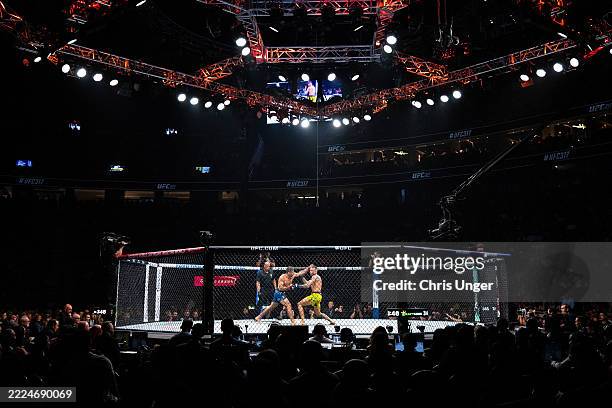
If you’re hooked on the non-stop action of modern MMA, you should know that this obsession was born in the intense heat of Brazil! What we tune in to watch on the UFC today actually started as the legendary “Vale-Tudo” (Anything Goes) duels in Brazilian gyms and public squares in the early 20th century.
It all revolved around the Gracie family. They had a singular mission: to prove that Brazilian Jiu-Jitsu (BJJ)—an art valuing technique over raw power—was the ultimate fighting system. They famously launched the “Gracie Challenge,” calling out boxers, capoeiristas, and wrestlers for highly unregulated matches. Vale-Tudo was often rough, but it was living proof that BJJ worked. Brazil didn’t just practice “no-holds-barred” fighting—it perfected it.
The sport went global in a massive way in 1993, when the Gracies brought their creation to the U.S. with the UFC (Ultimate Fighting Championship).
At the first event, the unassuming Royce Gracie shocked the world. He was the smallest and lightest competitor, yet he dominated the tournament, submitting giant opponents.
BJJ instantly became the martial art everyone had to train.
It was a messy, controversial transition, leading to bans and backlash, but the sport eventually grew up.
Thanks to the adoption of unified rules (making it safer and fairer), MMA evolved from a spectacle into an elite sport.
Today, to be a champion, you can’t just rely on one art; you must be a complete athlete, mastering Striking, Wrestling, and, of course, the Brazilian legacy: Jiu-Jitsu. And Brazil continues to deliver, remaining a talent factory that honors this incredible fight history.



Deixe um comentário